January Reading Notes

Hello, reader…

*Note to first time readers: the following is a summary of a discussion by friends and bookworms who gather monthly in a virtual space called Second Life. Book notes are lightly edited reflections shared in real time via text chat.

What a lovely way to welcome the new year.

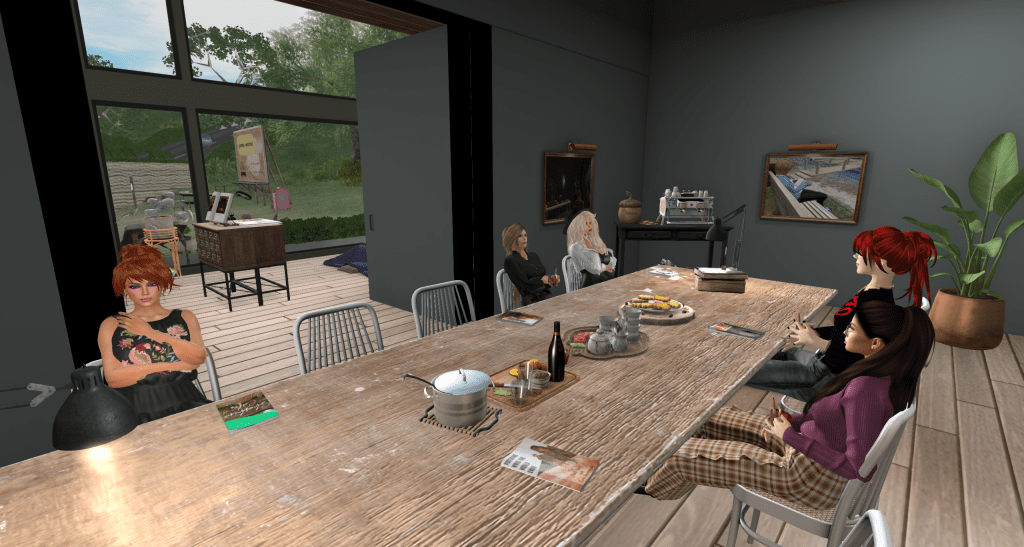
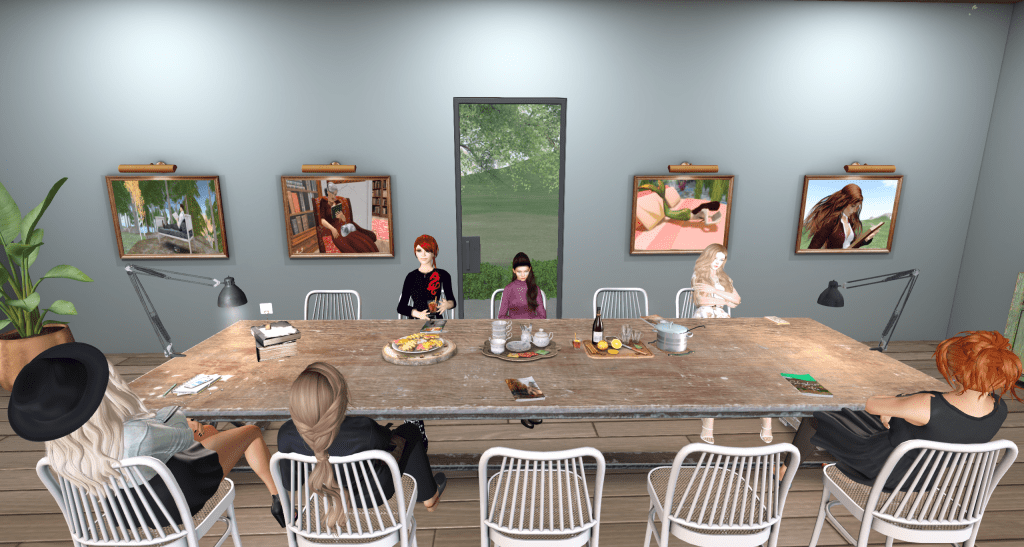
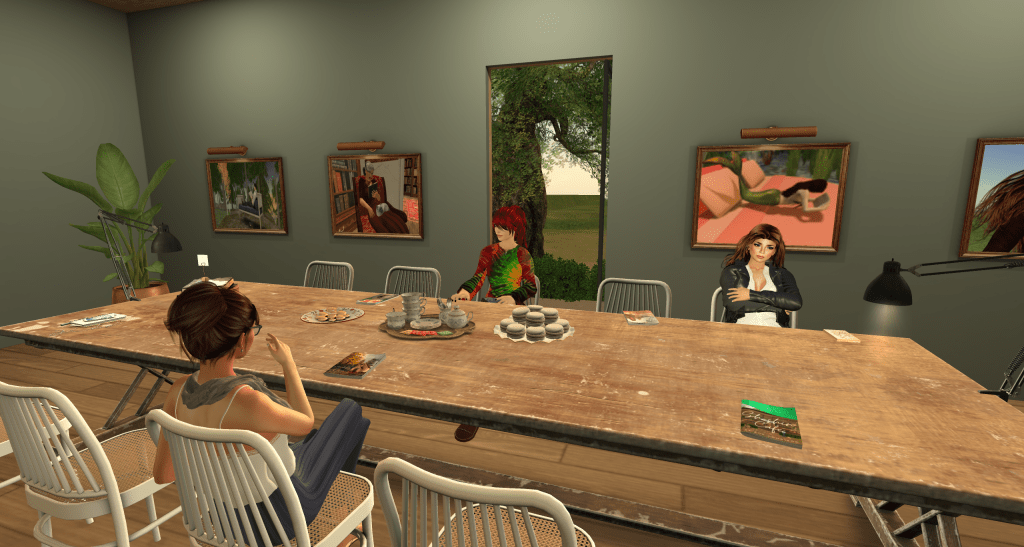
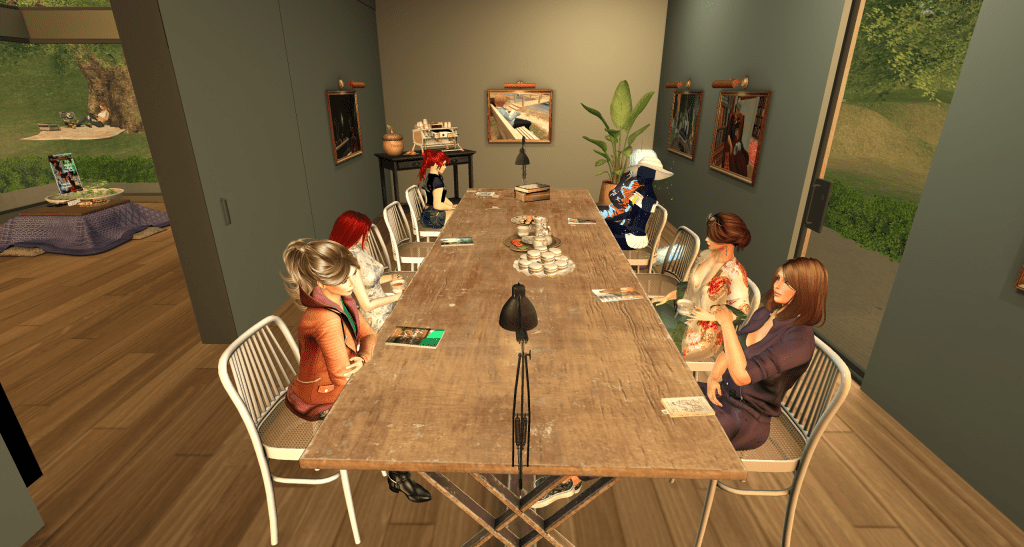
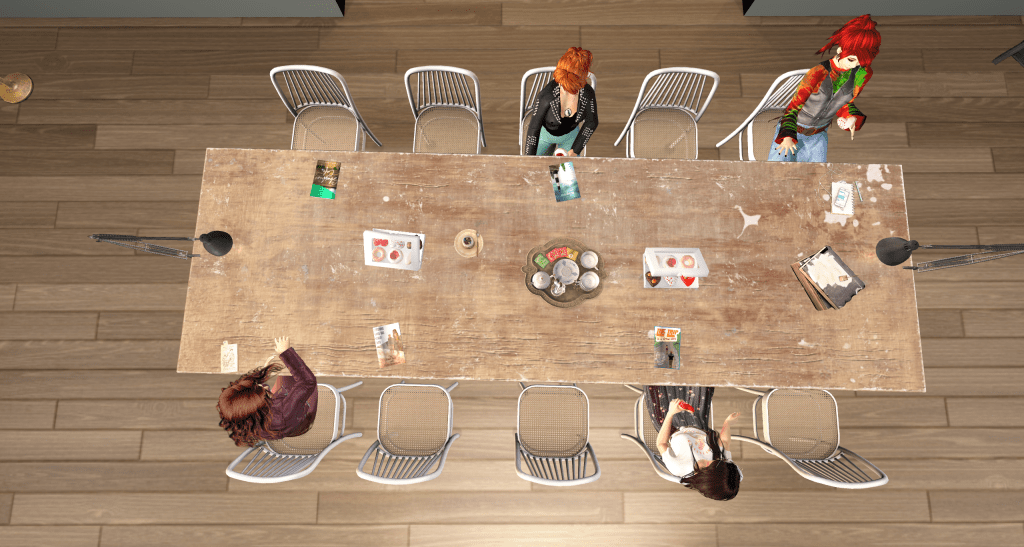
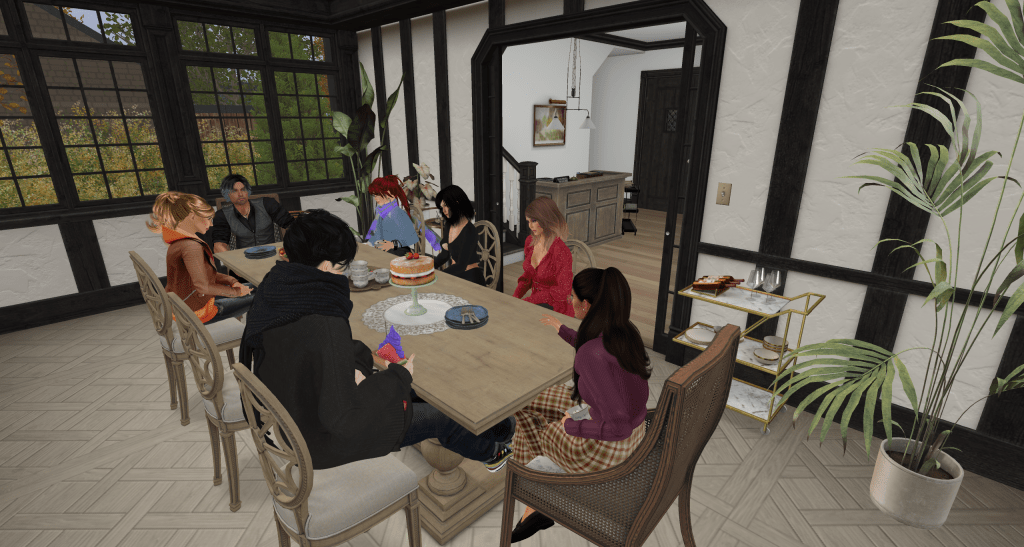
Old and new friends made their way to our new reading room in the Somdari region of Jeogeot for our first Book Lovers Coffee Hour of 2024.

It was clear that we’d all been blessed with time to read over the holidays – hooray! Here is a sampling of some of those reads…

Sounds Like Titanic: A Memoir by Jessica Chiccehitto Hindman

Veyot read a book about the travels of a music group that performed all over the USA for about 4 years and filmed 2-hour nature specials for PBS – but, they only pretended to play their instruments while recorded music played. The book earned it’s title because people thought the music sounded like the movie soundtrack. Veyot found the memoir to be both humorous and serious.

Dead by Proxy and Hunted by Proxy – a series by Manning Wolfe

FireWoman dove into these thrilling lawyer mysteries by Manning Wolfe, an RL lawyer based in Austin, Texas. Wolfe writes short mysteries with other authors, called Bullet Books. She encouraged us all to read them – “you won’t go wrong reading Manning!”.

Birnam Wood by Eleanor Catton

Fleming recently read this slow-paced eco-thriller about a gardening guerilla collective. He commented that it’s a good read, very political, about idealism versus capitalism. And as the title suggests, in the end it’s very Shakespearean.

frank: sonnets by Diane Seuss

Fleming is also reading this collection of sonnets. Through this most formal of all poetic forms, Seuss tells a story that Fleming described as fascinating. It is the winner of the 2022 Pulitzer Prize in Poetry – and many other prizes.

System Collapse – part of the Murderbot Series by Martha Wells

Sierra had been anticipating the publication of this book for months, which picks up right after the previous installment of the series. The series itself focuses on the adventures of a kind of Blade Runner-ish cyborg character that is a ‘SecUnit’–security unit. In the series, these are mostly controlled by different corporations and have a lock on their being autonomous via a ‘governor module’.

The first book started with our Murderbot (the name it used to describe itself) hacking its governor module and thereby becoming a free agent. By book 7,  our SecUnit is basically working for/part of a different non-corporate entity.  They are down on a planet that was settled but then abandoned .. but there are still some descendants of the colonists there. Book 7 is basically about preventing another corporation from moving in.

Sierra commented that the book is enjoyable but one thing .. since it is very much a continuation of the story from the previous book… she did find that she had forgotten certain things… who certain characters were, etc. So this is maybe a case where it is good to re-read the previous books before starting this one.

She’s enjoying this series and hopes Wells keeps writing these stories.

Kissa by Kissa: How to Walk Japan and Things Become Other Things by Craig Mod

For Christmas, Zoe received 2 books that she’d been lusting after for awhile but never bought. So her husband kindly gifted them to her! They’re both self-published – though Random House has picked up the second book so hopefully they’ll be seen stateside in 2025.

The author is an American who has lived in Japan for the last 23ish years. His name is Craig Mod. His books document his journeys on foot through various landscapes in Japan.

The first book, Kissa by Kissa: How to Walk Japan, focuses on the Japanese coffeehouse, known as ‘kissa’ or kissaten. He journeys 1000+ kilometers, speaking to kissa owners and sampling what kissa are known for – pizza toast!

The second book is ‘Things Become Other Things‘. Again, Mod walks thousands of miles through the countryside, talking to local folks, and observing the decline he sees in some of the towns. This was my favorite of the two because it’s also about a friend of his whom he lost and what grief looks like as it traverses the passage of time.

Here’s a link to a short documentary by the author about the craftspeople involved in the making of the first book. https://www.youtube.com/watch?v=l4u5_UyQoyw

Things Become Other Things is the best book Zoe read all year. Possibly in several years. And the book itself is an object of beauty. 🙂


Our next gathering is February 11 at 1pm SLT. All are welcome – bring a friend!

November Reading Notes

Hello, reader…

Happy holidays, bookworm friends!

During our November gathering, I mentioned that I’m opening a second reading room – a space with ties to our Shoshin Reading Room as well as the Seogyeoshire Library.

I’m calling it the Somdari Reading Room – named after the Jeogeot region where it lives. The image above is a snapshot of the entry room. There are two other rooms – works in progress – which will foster community gatherings as well as cozy reading nooks.

A guided tour will be given after the holidays – date and time, tbd.

Meanwhile, here is the roundup of books that were mentioned at our most recent gathering. It’s an intriguing list – please enjoy!

Dead by Proxy by Manning Wolfe

This is the first book in a new action suspense series, set in Austin, Texas. FireWoman has read several of Wolfe’s books and recommends them, particularly to readers who enjoy a quick get-to-the-who-done-it.

Nothing More Dangerous by Allen Eskens

Veyot shared this novel about two teenage boys who solve a mystery by finding a corpse in the woods and locating the killer’s car. Though Veyot usually doesn’t like teenage characters, she would recommend this as a choice for high school reading. She compared it to To Kill a Mockingbird — with boys instead of a girl as the main character.

MacArthur Park by Judith Freeman

Also shared by Veyot, this is a philosophical look at a long marriage of a couple who live near MacArthur Park in Los Angeles. It includes lots of quotes from famous authors and mentions the song, MacArthur Park. The couple thinks the song is about the decline of the park, but it’s really about a failed romance

The Honeys by Ryan La Sala

FireWoman also read this YA magical mystery book and commented that La Sala’s style is unique and dark. She recommends his other titles, The Big Read: Reverie and Bedazzled as well.

Shadow of the Fox by Julie Kagawa

FireWoman recommends this YA series that mixes Japanese fairy tales, folklore, and history.

What You Are Looking For Is In The Library by Michiko Aoyama, translated by Alison Watts

Written along the vein of Before the Coffee Gets Cold, Zoe read this collection of short stories about a seemingly magical librarian. Each story focuses on someone who is struggling and somehow ends up at the same library, speaking with the same librarian. Each person is able to work through their issue based on the books that the librarian recommends.

Days at the Morisaki Bookshop by Satoshi Yagisawa

Zoe also recommends this cozy modern Japanese novel.


Our next gathering is January 14th at 1pm SLT. ‘Til then – happy holidays and happy reading!

October Reading Notes

Hello, reader…

One of the things I enjoy most about our coffee hour is the exposure to so many different new-to-me genres and authors. It was thus a pleasure to welcome three new friends to our monthly gathering – Konnie, Lomesse, and Roslyn – along with a couple of our regulars, to hear all about their intriguing recent reads…

Falling in Love with Joseph Smith: My Search for the Real Prophet by Jane Barnes

Veyot described this as a lighthearted history book whose author was a producer on a PBS documentary about the Mormons. Barnes apparently liked the stories about the teenaged Joseph so much that she seriously considered joining the Mormon church.

Glovemaker by Ann Weisgarber

Veyot also shared this novel that shows Mormon life in Utah in the 1880s, including the main character’s memories of her earlier life, the loyalties of Mormons to each other, and the government’s order to start prosecuting polygamists. To add suspense, there is a missing husband and a desperate stranger pursued by a federal marshal.

The Outlander series by Diana Gabaldon

Roslyn is in the midst of reading this popular series – and occasionally arguing with the author.

Footprints of the Welsh Indians: Settlers in North America Before 1492 by William L. Traxel

Roslyn also recently read a treatise on Welsh Indians. She said it was a sad story in the end because if they were here, they lost their ability to read and write their language – and so were lost in history. Ros described it as a dry but fascinating read.

Underdogs of Japanese History: 11 Iconic Characters Who Prevailed Against the Odds…Or Didn’t by Kyota Ko

FireWoman enjoyed this collection of great stories and well-researched ancient history of Japan. She recommends his first book, Folktales of Japan, as well as his social media accounts on LinkedIn and Instagram. He posts nearly every day – awesome stories!

Goodnight Racism by Ibram X. Kendi

Magnolia Flower by Zora Neale Hurston and Ibram X. Kendi.

FireWoman also enjoyed these two children’s books.

Chinese Menu: The History, Myths, and Legends Behind Your Favorite Foods by Grace Lin

FireWoman considers this a must-read! She was salivating as she read this brand new book by Newbery and Caldecott Honor author/illustrator Grace Lin.

I Never Promised You a Rose Garden by Joanne Greenberg

Lomesse shared this famous novel about schizophrenia and the author’s hospitalization in 1950. She commented that the world in that illness is very different but that the author did her best to capture it.

A Woman’s Story by Annie Ernaux, translated by Tanya Leslie

Zoe recently read this memoir about the author’s relationship with her mother who eventually died from complications related to Alzheimer’s disease. The author saw herself as an archivist of sorts, attempting to document her mother’s life in a way that presented her as a fully formed woman.

The Bookshop of the Broken Hearted by Robert Hillman

At its heart, this is a love story set in the Australian countryside, in the 1960s. Zoe thought it was going to be about a bookshop…it it is, and isn’t. The man is a farmer who has such a good heart but has also experienced a lot of loss. His love interest is a woman who, among other experiences, spent time in Auschwitz. They bond over books and their experiences with learning how to build a life while wrangling with grief. Zoe thought it was really beautiful.


Our next gathering is November 19th at 1pm SLT. See you then – bring a friend!

September Reading Notes

Hello, reader…

We received not one but TWO poems in our mailbox – yay!
Here is the first one:

Surrounded

bottom feeders are

gonna bottom feed

but what are all

these hungry ghosts

doing stuck up in our heads

gee I wonder?

It was written by a resident named Elan. Check out his original art here.

Here’s the second poem, by Manow Bellic:

A soulful link, so pure and true,

Ignited by a coffee brew,

A bond that’s grown, steadily strong,

In friendship’s garden, it belongs.

Did I mention, a coffee’s grace,

The genesis of this embrace?

Through sips and words, it found its start,

A tale of two souls, a work of art.

Thanks to Veyot for sparking this wonderful project! Our poem mailbox has been such a lovely way to connect with talented inworld poets.

And now, on to this month’s book notes!

Weyward by Emilia Hart

Shelved in historical fiction, but also referred to as “Witch Lit”, this is the story of three women who share an ancestral line but live in three different time periods. Each woman encounters tragedy but works through it with the help of a bit of magic – magic born of strong ties to nature, rather than the abracadabra sort. Zoe considered this a page-turner. She sympathized and was inspired by each woman – they showed remarkable strength and resilience. Also, it has a gorgeous cover!

Legends and Lattes by Travis Baldree

This is a cozy fantasy about an orc who changes careers and opens a coffee shop with the help of a succubus, a hobgoblin, and a rat. Zoe thought this was a fun read! No one in the village had ever heard of coffee or cinnamon rolls. The orc renovated an old livery to create her shop and brought in a coffee machine made by goblins. Apparently goblins have all the cool tech.

Armageddon Averted: The Soviet Collapse (1970-2000) by Stephen Kotkin.

Sierra’s delve into Russian history continued with this title, which she commented was more satisfying than some of her other recent reads around the same topic.

Sierra also picked up these books for her TBR pile:

The Loom of Time: Between Empire and Anarchy, from the Mediterranean to China by Robert D. Kaplan

The Ghost at the Feast: American and the Collapse of World Order, 1900-1941 by Robert Kagan

The Milky Way: An Autobiography of Our Galaxy by Moiya McTier


Our next gathering is October 8th at 1pm. See you then – bring a friend!

August Reading Notes

Hello, reader…

It’s so hard to believe that summer is almost over! But I must admit – I’m looking forward to fall. It will be so lovely to curl up with a good book and a pumpkin flavored treat, won’t it?

Anyhoo, here’s the roundup from our August gathering. There are definitely some gems here!

Daughter of Fortune by Isabel Allende

This is the first of the trilogy that FireWoman mentioned during our July gathering. It starts in Chile in the 1830s and ends in California in the 1850s. The story is of the 1849 Gold Rush to California and the influx of people from all over the world to the area. It is the first mention of the families written about in Allende’s The House of the Spirits.

FireWoman very much enjoyed this series…and noticed that her sleeping dreams have been more prominent and more vivid while reading Allende. Isn’t that neat?

Soviet Fates and Lost Alternatives: From Stalinism to the New Cold War by Stephen F. Cohen

Along the same vein of her July reads, Sierra picked up this 2009 book that has her hovering around the question of…why did the Soviet Union collapse?

The Soviet Century: Archaeology of a Lost World by Karl Schlogel

Sierra also found this ENORMOUS TOME of a book (822 pages not counting the index!) that is like an archaeology encyclopedia. It has chapters on how housing was built in the Soviet Union or the mausoleum, etc. She’s been treating it as something to dip into rather than something to read straight through.

The Quickening: Creation and Community at the Ends of the Earth by Elizabeth Rush

Sierra stumbled upon this book that she hasn’t read but looks intriguing. Here are some related articles with information on the book by the author.

We Reached the Glacier Just as it Collapsed: The world’s widest glacier is melting–and changing predictions about our planet’s future. By Elizabeth Rush, in The Atlantic (paywall).

What Antartica’s Melting Glaciers Taught Me About Becoming a Mother by Elizabeth Rush.

Inseperable by Simone de Beauvoir

Zoe picked up this book at an antique store for $3, though it was published in 2021. It’s a novel inspired by the author’s real life friendship with Zaza Lacoin. It follows two young girls as they explore life in post WWI France and how their friendship shapes their philosophies on life. Zoe thought that it was beautifully written and especially enjoyed the real life letters at the end between de Beauvoir and Lacoin.


Our next gathering is September 10th at 1pm. See you then – bring a friend!

July Reading Notes

Hello, reader…

It’s been a busy summer but I’m so happy we were able to squeeze in a gathering for July. As always, many intriguing titles were shared…I hope you find something among them to pique your interest.

A History of the Soviet Union: From the Beginning to Its Legacy, 3rd Edition by Peter Kenez

Sierra is partway through this one and commented that it’s pretty readable and fairly concise. She observed that one of the trade-offs in any history book is what the author chooses to focus on – which details to include and when to provide a mere overview. Here, for example, there is more treatment of the Bolsheviks as a group with a bit more color around Lenin while not necessarily getting into a great deal of detail. Overall, Sierra is enjoying this book.

Armageddon Averted: The Soviet Collapse, 1970-2000 by Stephen Kotkin

Along with the Kenez book, Sierra is also reading this more focused history and noted that it’s interesting to read a history about a period of time that she lived through (though not living in Russia). The Kotkin book is very readable and enjoyable.

The Autobiography of Mrs. Tom Thumb by Melanie Benjamin

FireWoman read this historical fiction about a woman who was born at average weight and length, but stopped growing when she was really young. She was not a dwarf, but a diminutive-sized person. Her younger sister was born the same. All other siblings were normal sized. This is the same thing for the real Tom Thumb who was with Barnum Circus. It is her story and what a story it is. Firewoman really enjoyed this read – she couldn’t put it down! – though it was sad in parts.

The Wind Knows My Name by Isabel Allende

With a renewed desire to read more Allende, Firewoman picked up this story of a young Austrian boy who survives Kristallnacht and sent to London with other Jewish children to be safe from the oncoming war. The other side of the story is a young girl in El Salvador during contemporary times who is escaping the murder and crime in her country to come to the United States.

The Little Prince by Antoine de Saint-Exupery

FireWoman initially borrowed this in eBook format from her local library and found the translation to be horrible. So she looked for a different translation and enjoyed it very much.

The Electricity of Every Living Thing: A Woman’s Walk in the Wild to Find her Way Home by Katherine May

Zoe read this book about a woman who walks the South West Coast Path in England to spend time with herself and try to make sense of her behavior. Along the way, she listens to a radio programme and a lightbulb goes on in her head….that she’s autistic. So the book is about her walk and about her journey to confirm that she’s autistic…and what to do with that diagnosis and her new vocabulary. Zoe enjoyed the self-discovery bits but found the descriptions of the actual walk to be rather boring.


The date for our August gathering is TBD….but coming soon!

June Reading Notes

Hello, reader…

I forgot to take a picture of our gathering but it was lovely! Each book shared went directly on to my reading list – I think you’ll find them intriguing, too.

Zelda Fitzgerald: Her Voice in Paradise by Sally Cline

FireWoman didn’t know anything about Zelda Sayre Fitzgerald before reading this book. Author and researcher Sally Cline did justice for Zelda in this book with her in-depth research beyond what has been written by previous biographers of Zelda’s life. Cline made pointed comments where she found differences in previous books about Zelda. Cline also goes into great detail with Zelda’s pursuits into writing, paintings, and ballet.

FireWoman cautions that the eBook via Hoopla is rife with missing punctuation, mostly absent periods, and misspellings – all of which made the book difficult to read. But aside from that, it was an excellent read.

Desert Solitaire by Edward Abbey

A riveting capsule of time in the great outdoors with political commentary from the author. Abbey was a seasonal park ranger in Utah’s Arches National Monument at the time. An adventurer, he went down the Colorado River without a map or life preservers! FireWoman thought it was an exciting read of a history of a time and place.

The Invisible Life of Addie LaRue by V.E. Schwab

A second readthrough for Alas, she shared that she enjoyed all the little insights as the character went along. Lots of pithy comments and observations. She also felt that the author seemed to change direction toward the end, which made for an unsatisfying ending. She’s curious to hear what others think about the ending!

An Attempt at Exhausting a Place in Paris by George Perec

This is a book that was referenced in a memoir that Sierra read last month called, ‘No. 91/92: A Diary of Year on the Bus‘ by Laren Elkin. Perec situated himself in a particular part of Paris for a few days and basically wrote down what he saw….busses that pass by…people that pass by…signage…birds, etc. It’s a kind of snapshot of a day and place in October 1974.

Sierra mentioned that it can be helpful to have the translator’s notes to help provide additional context about Perec…who was a very unusual writer. He wrote another book without the letter ‘E’ apparently!

Perec’s book is free to read here.

Sensitive: The Hidden Power of the Highly Sensitive Person in a Loud, Fast, Too Much World by Jenn Granneman and Andre Solo

This is a recently published book by a married couple who identify as highly sensitive people or HSP. Zoe thought it was an easy read – clearly written for the masses – that attempts to define and offer guidance to HSPs. Recommended for readers who are fairly new to the topic.

The Way Through the Woods: On Mushrooming and Mourning by Long Litt Woon

Zoe is halfway through this memoir about a woman’s journey through her grief of the loss of her husband by studying mycology and becoming a mushroom inspector. Zoe loved Woon’s writing style – which feels like sitting over the kitchen table with a really smart, nerdy friend.


Our next gathering will be on Sunday, July 9th at 1pm SLT. Hope to see you then!

May Reading Notes

Hello, reader…

Our May gathering was cozy yet bubbling with conversation. Several intriguing titles were shared – hopefully these will pique your interest.

A Snake Falls to Earth by Darcie Little Badger

This is a young adult novel by a geoscientist, writer, and fan of the weird, haunting and beautiful.

It’s about the connection between a young Lipan girl, Nina, and a boy, Oli, who lives in a parallel world, in “the land of spirits and monsters”. Though they’ve never met, there are forces working to ensure they never will.

FireWoman thought it was a fantastic read. Nina’s world is facing the same problems of vanishing ecosystems as we are today. What happens in Nina’s world affects Oli’s world.

Elatsoe by Darcie Little Badger

FireWoman also read Badger’s debut novel. It’s about another Lipan Apache girl, Elatsoe, whose cousin is murdered. In a world of magic and monsters, Elatsoe relies on her inherent gifts to uncover the mystery behind this crime.

FireWoman learned about this author through an interview on National Public Radio. If you also enjoy young adult novels, storytelling and magic, you’ll enjoy this author, too.

My Invented Country: A Nostalgic Journey Through Chile by Isabel Allende

A memoir by a well-known author who responds to the question: from where does she draw her nostalgia?

FireWoman commented that Allende writes like she is in the same room with you, just visiting among friends.

The Cockroach by Ian McEwan

Except where the character of Gregor Sansa wakes up to find that he has changed into a giant cockroach, McEwan’s protagonist is a roach that wakes up in the body of a man. But not just any man!  Our protagonist wakes up in the body of the Prime Minister of Great Britain.  He isn’t alone either — and is on a mission. 

Ultimately this is a satire on Brexit and some of the characteristics of politics in the UK — and to a lesser extent — the US. 

Sierra thought it was a fun read overall.

No. 91/92: A Diary of a Year on the Bus by Lauren Elkin

Sierra also read this short set of journal entries that Elkin made while taking the bus in Paris to and from the school. Elkin was a teacher there from 2014 to 2015. Her entries were written as a set of short notes that she made on her iPhone.

Sierra felt this one was maybe hit or miss — she can see that it would have been tricky to write much on a phone on a bus which at times seems like it would have been crowded.

The most interesting bit was the last entry .. which no doubt was developed further and not just while sitting on a bus.

Elkin mentions George Perec’s ‘An Attempt at Exhausting a Place in Paris’ (1974). It’s a memoir that reflects on a time when Perec sat for three days in the same place and wrote down everything that he saw. Sierra thought perhaps Perec’s book inspired Elkin’s experiment.

The Words in My Hands by Asphyxia

Asphyxia is a Deaf Australian writer (her perspective on Deafness is that it’s its own culture, hence the capilization).

This fictional memoir is written in diary form. The pages are decorated in a kind of art journal style. It’s fiction, set in the near future, where the environment is wrecked and food is scarce. The protagonist is a Deaf teen who – long story short – ends up learning to garden and cook while most of the world is reliant on bioengineered “food”. There’s a love story…and a lot about community building.

Zoe thought it was a good read.

How Romantics and Victorians Organize Information by Jillian M. Hess

Zoe just started on this non-fiction book about commonplace books and scrapbooks and how they were kept in the 19th century. Though she’s only a chapter in, she recommends it.


Our next gathering will be on Sunday, June 11th at 1pm SLT. Hope to see you then!

March Reading Notes

Hello, reader…

Happy spring!

I have some wonderful titles to share with you, compliments of the Reading Room bookworms…

The Folded Clock: A Diary by Heidi Julavits

The title of this book comes from a mixed up conversation that the author had with her daughter who thought that the author said “folded clock” instead of “folded cloths”.

The author remembers writing in a diary every day for several years as a child. She pretends to write a diary now, but it is not her daily happenings, but a daily memory of something.

She writes about old friends, dinner parties, a writers convention in Germany, and a writers conference in Italy. And it’s mostly things that annoyed her!

One thing in the book made the reader, Veyot, go off on a tangent – the author tells how her last name, Julavits, causes people to guess that she might be Jewish, but she is not as far as she knows. Strangers write letters insisting that she is their relative, misspelled. Jolowitz, or even Jewelvitz.

Though Veyot enjoyed the book she doesn’t recommend it for everyone. If you don’t mind an author who is often annoyed, then this might be a good read for you.

Let Me Tell You What I Mean by Joan Didion

This is a collection of both shorter and longer articles that span 1968-2000. Sierra commented that there is an aspect of…maybe…ethnographer in her work. Didion tends to be a good observer of her place, writing about details of some place but also not getting bogged down either.

To echo Veyot’s comment about The Folded Clock, there are times where Sierra thought that parts of Didion’s work reflects annoyance at certain things. But it comes off well and Sierra didn’t think it would put anyone off.

Sierra also found that there is a lot in Didion’s articles that read as auto-biographical .. what Didion thinks of her own development as a writer is interesting.. what she thinks of as her limitations…for instance she doesn’t think she could be an academic .. that she didn’t have access to the ‘world of ideas’. There is maybe something in that which gives her writing a very grounded-in-reality feel.

Sierra has another book of Didion’s that she wants to get into…South and West, which is from some notebooks she kept on a trip once.

Four Hundred Souls: A Community History of Africa America, 1619-2019 by Ibram X. Kendi

90 writers contributed essays and poetry to this 2020 book. Kendi has written the book “How to be an Anti-racist”, “How to raise an antiracist”, and “How to be a young anti-racist”. The book spans 400 years in five year increments.

FireWoman discovered this book via LinkedIn and was glad she did.

Toussaint Louverture by Charles Forsdick

Toussaint Louverture was the founding father of Haiti and the leader of the first successful black slave rebellion in the Caribbean. According to Callista, the book is very factual, short, and concise – but not well-organized. She found the story of Louverture tragic but also complex. An interesting history perhaps pursued via a different author.

The Hole by Hiroko Oyamada

Zoe found this Japanese novel entertaining but befuddling. She’d shelve it under magical realism. It’s about a woman who moves with her husband to his hometown and the strange (possibly imaginary?) people she meets there.

All the Beauty in the World: The Metropolitan Museum of Art and Me by Patrick Bringley

This is a quiet, gentle memoir by a former writer for the New Yorker who spent 10 years as a guard at the Metropolitan Museum of Art. Zoe recommends it for when you’re in a quiet mood. It was a pleasant read.

A short list of these books may be found here.


Our next gathering will be on Sunday, April 9th at 1pm SLT. Hope to see you then!

February Reading Notes

Hello, reader…

Exciting news – we received a poem in our poetry mailbox! It’s a haiku authored by Blink Hexem.

Here it is…

Light gathers in spring,

Sunlit shafts pierce the forest,

Moss grows on old bone.

Isn’t it lovely?

Here are the books shared during our February gathering…

The Spare Man by Mary Robinette Kowal

This is a kind of classic murder mystery like you might have in the 20s and 30s – but set in some future time aboard a ship traveling from the Moon to Mars. The protagonist is a wealthy industrialist woman — recently married and on her honeymoon — when a murder happens, implicating her husband.

Sierra is still making her way through this one and commented that so far it’s a bit hit and miss. Somehow she’s not connecting with the protagonist…and it is like the author has set up all these links about her but hasn’t really connected them. She found the accused husband more interesting but the story isn’t told from his viewpoint.

Also – the story maybe has the best descriptions of a small white terrier service dog. 🙂

The Philosophy of Modern Song by Bob Dylan

Veyot read about this on a book blog, which described it as a coffee table book. It’s pretty, has lots of photos, and is very skimmable. Though she didn’t know many of the singers discussed, she liked the style of writing. Dylan often digressed to something else about each song or singer…and talked about rhyming schemes.

Shadows on the Rock by Willa Cather

FireWoman read both this one and another Cather book – both were seemingly well-researched historical fiction using easy flowing narrative with personable characters.

The Wind Done Gone by Alice Randall

An unauthorized parody of Margaret Mitchell’s Gone with the Wind, written from a slave’s perspective.

Folk Tales of Japan: 28 Folk Tales with Cultural Commentary by Kyota Ko

FireWoman read this collection by an author she follows on LinkedIn, where he offers Japanese culture and history notes daily. His tellings are contemporary and the history of the times is very in depth.

Other Birds by Sarah Addison Allen

Zoe said she’d shelve this one under magical realism. It’s about a young woman who goes to live on an island mostly unfamiliar to her, where her mother left her a condo. In this very small condo complex are an interesting cast of characters, each haunted – mostly lovingly – by someone from their past. The stories behind these hauntings are the main focus of this book and the big themes are processing grief and letting go. And also, celebrating ones uniqueness.

Zoe thought it was a little cheesy and predictable but an otherwise enjoyable read.

Old Age: A Beginner’s Guide by Michael Kinsley

A kind of memoir/collection of essays about aging and living with Parkinson’s. Zoe found parts of it interesting but also skimmed some parts.

A short list of these books may be found here.


Our next gathering will be on Sunday, March 12th at 1pm SLT. Hope to see you then!