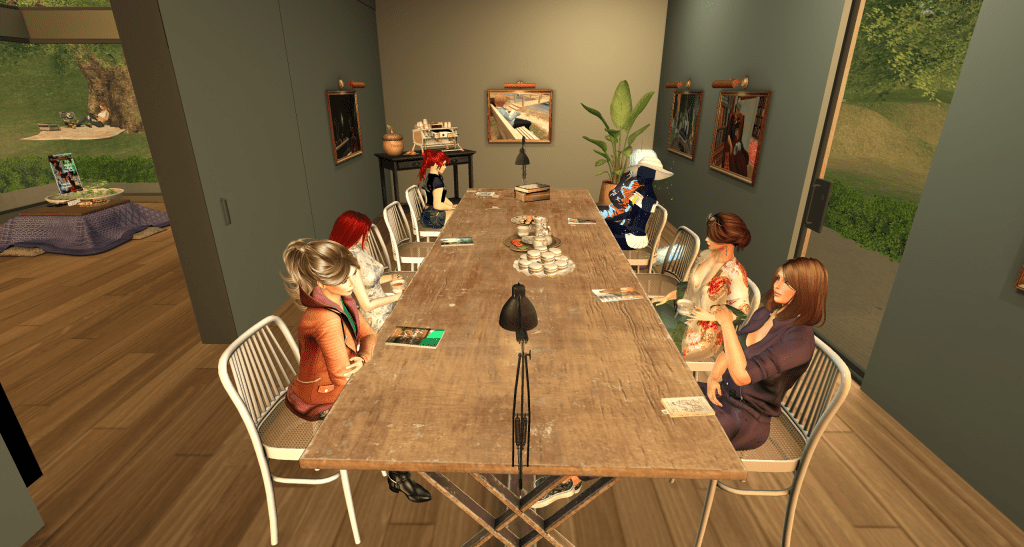
Hello, reader…
Happy spring!
I have some wonderful titles to share with you, compliments of the Reading Room bookworms…
The Folded Clock: A Diary by Heidi Julavits
The title of this book comes from a mixed up conversation that the author had with her daughter who thought that the author said “folded clock” instead of “folded cloths”.
The author remembers writing in a diary every day for several years as a child. She pretends to write a diary now, but it is not her daily happenings, but a daily memory of something.
She writes about old friends, dinner parties, a writers convention in Germany, and a writers conference in Italy. And it’s mostly things that annoyed her!
One thing in the book made the reader, Veyot, go off on a tangent – the author tells how her last name, Julavits, causes people to guess that she might be Jewish, but she is not as far as she knows. Strangers write letters insisting that she is their relative, misspelled. Jolowitz, or even Jewelvitz.
Though Veyot enjoyed the book she doesn’t recommend it for everyone. If you don’t mind an author who is often annoyed, then this might be a good read for you.
Let Me Tell You What I Mean by Joan Didion
This is a collection of both shorter and longer articles that span 1968-2000. Sierra commented that there is an aspect of…maybe…ethnographer in her work. Didion tends to be a good observer of her place, writing about details of some place but also not getting bogged down either.
To echo Veyot’s comment about The Folded Clock, there are times where Sierra thought that parts of Didion’s work reflects annoyance at certain things. But it comes off well and Sierra didn’t think it would put anyone off.
Sierra also found that there is a lot in Didion’s articles that read as auto-biographical .. what Didion thinks of her own development as a writer is interesting.. what she thinks of as her limitations…for instance she doesn’t think she could be an academic .. that she didn’t have access to the ‘world of ideas’. There is maybe something in that which gives her writing a very grounded-in-reality feel.
Sierra has another book of Didion’s that she wants to get into…South and West, which is from some notebooks she kept on a trip once.
Four Hundred Souls: A Community History of Africa America, 1619-2019 by Ibram X. Kendi
90 writers contributed essays and poetry to this 2020 book. Kendi has written the book “How to be an Anti-racist”, “How to raise an antiracist”, and “How to be a young anti-racist”. The book spans 400 years in five year increments.
FireWoman discovered this book via LinkedIn and was glad she did.
Toussaint Louverture by Charles Forsdick
Toussaint Louverture was the founding father of Haiti and the leader of the first successful black slave rebellion in the Caribbean. According to Callista, the book is very factual, short, and concise – but not well-organized. She found the story of Louverture tragic but also complex. An interesting history perhaps pursued via a different author.
The Hole by Hiroko Oyamada
Zoe found this Japanese novel entertaining but befuddling. She’d shelve it under magical realism. It’s about a woman who moves with her husband to his hometown and the strange (possibly imaginary?) people she meets there.
All the Beauty in the World: The Metropolitan Museum of Art and Me by Patrick Bringley
This is a quiet, gentle memoir by a former writer for the New Yorker who spent 10 years as a guard at the Metropolitan Museum of Art. Zoe recommends it for when you’re in a quiet mood. It was a pleasant read.
A short list of these books may be found here.
Our next gathering will be on Sunday, April 9th at 1pm SLT. Hope to see you then!

 The Reading Room